
Stop Backyard Breeding in Contra Costa County, CA: Demand a Tip Line Now
The Issue
Over the last ten years, a small but mighty group of citizen rescuers in Contra Costa County, California, has been working tirelessly to save the lives of at-risk shelter dogs- a mission that grows more urgent and challenging with each passing year. Amid the many challenges facing our shelter system, one issue stands out as a root cause of animal suffering and overcrowding: illegal and/or irresponsible backyard breeding.
WHAT IS BACKYARD BREEDING?
Backyard breeding is defined by leading animal welfare organizations as the practice of breeding animals—especially dogs—on a small scale and without proper regard for health, behavior, or welfare. These breeders often lack veterinary oversight, do not conduct genetic testing, and operate without licenses or accountability.
Too often, the animals used for backyard breeding are kept in unsafe, inhumane conditions: confined in filthy spaces, denied medical care, and exploited solely for reproduction. Mothers are bred repeatedly, and puppies are separated too early or sold online without vetting or adoption contracts.
Making matters worse, unregulated breeders often fail to spay or neuter their animals, resulting in repeated, unchecked litters in a county already overwhelmed with dogs. Contra Costa County ordinance, specifically Section 416-6.216, restricts the number of litters a person can allow from their dogs and cats within a calendar year—but without enforcement, this regulation is easily ignored. Since the market for puppies is already saturated, many of these animals are ultimately dumped, abandoned, or surrendered to shelters, where they face an uncertain future—especially in overcrowded systems already at capacity. These puppies flood our shelter, stretching limited resources to the breaking point. Despite being healthy and adoptable, many of these young animals are euthanized simply because there’s no space left.
THE NUMBERS DON'T LIE
This is a national crisis with local consequences:
- According to the ASPCA, 3.3 million dogs enter U.S. shelters each year
- 670,000 are euthanized annually, many due to space and resource limitations
- In Contra Costa County, our shelter system is stretched thin and often at capacity with an 11% increase in dog intake since 2021—dogs are turned away or put on euthanasia lists daily
- If the current 2025 trend continues in Contra Costa Animal Services, shows a 39.5% increase in dog euthanasia compared to 2024 - from 314 to 438 (projected 2025)
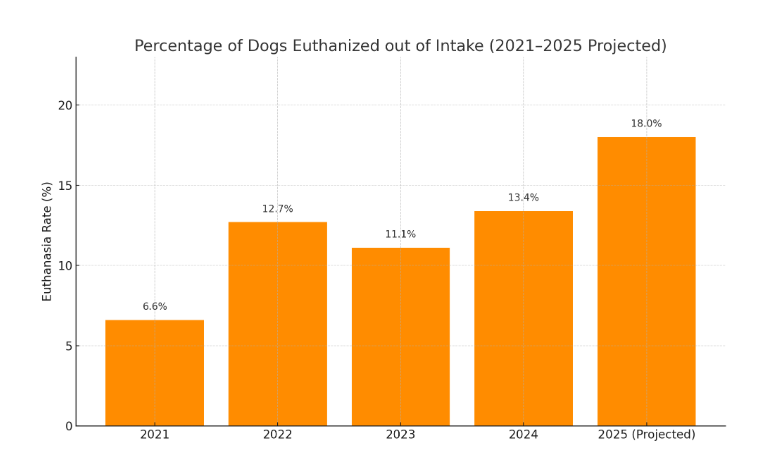
The chart showing percentage of dogs euthanized out of intake (RTO removed) in Contra Costa County, CA from 2021 to 2025 (projected).The rising trend clearly underscores the urgency of intervention—like implementing a tip line to curb irresponsible breeding. (AACCC, 2025)
A SIMPLE, POWERFUL SOLUTION: THE BACKYARD BREEDING TIP LINE
We believe Contra Costa County can take an effective, immediate step: create a community tip line where residents can report suspected backyard breeders.
This model works. In 2024, Los Angeles County launched a similar tip line, and within months:
- 434 tips were submitted
- 256 enforcement actions were taken—nearly a 60% enforcement rate
- Illegal and unlicensed breeders were shut down or fined
Community-led reporting leads to real enforcement.
HOW IT COULD WORK IN CONTRA COSTA COUNTY, CA
- Simple Reporting Options: An online form and dedicated phone line would allow residents to submit confidential reports, including location info, photos, or evidence from online ads.
- Anonymous or Named: Tipsters could choose to remain anonymous or provide contact info for follow-up.
- Triage and Action: Animal Services would review incoming tips and conduct inspections when warranted, issuing citations or taking legal action as needed.
- Data-Driven Oversight: Each tip would be logged and tracked—ensuring transparency, accountability, and measurable outcomes.
- Community Education: Volunteers, local advocates, elected officials, rescues and those in the shelter ecosystem can help promote the tip line and educate the public on backyard breeding harms.
BUDGET AND IMPLEMENTATION CONSIDERATIONS
We understand new programs require resources—but this one is cost-effective and scalable:
- Minimal setup costs: LA County leveraged existing phone lines and online systems—Contra Costa can do the same.
- Enforcement staffing: Investigations would be incorporated into existing Animal Services workflows, not requiring major staffing changes.
- Community support: Volunteers and rescue groups could assist with outreach, awareness, and non-enforcement-related admin tasks.
- Grants available: State and federal animal welfare grants may help offset any incremental costs.
- Long-term savings: Reducing shelter intake and euthanasia lowers operational costs and improves live release outcomes.
WHY THIS MATTERS
Every dog deserves a chance at a safe, loving home. Backyard breeding denies animals that chance—and contributes to a cycle of neglect, abandonment, and euthanasia. A tip line empowers the public to intervene before it's too late.
Behind every rescue success story is a moment of action. A community tip line can make those moments possible—again and again.
We urge Contra Costa County to create and launch a backyard breeding tip line. It’s smart, scalable, and it saves lives.
Sign this petition to stand with us—and speak up for the animals who can’t speak for themselves! Together, we can protect our shelters, our communities, and most importantly, the dogs who depend on us.

1,301
The Issue
Over the last ten years, a small but mighty group of citizen rescuers in Contra Costa County, California, has been working tirelessly to save the lives of at-risk shelter dogs- a mission that grows more urgent and challenging with each passing year. Amid the many challenges facing our shelter system, one issue stands out as a root cause of animal suffering and overcrowding: illegal and/or irresponsible backyard breeding.
WHAT IS BACKYARD BREEDING?
Backyard breeding is defined by leading animal welfare organizations as the practice of breeding animals—especially dogs—on a small scale and without proper regard for health, behavior, or welfare. These breeders often lack veterinary oversight, do not conduct genetic testing, and operate without licenses or accountability.
Too often, the animals used for backyard breeding are kept in unsafe, inhumane conditions: confined in filthy spaces, denied medical care, and exploited solely for reproduction. Mothers are bred repeatedly, and puppies are separated too early or sold online without vetting or adoption contracts.
Making matters worse, unregulated breeders often fail to spay or neuter their animals, resulting in repeated, unchecked litters in a county already overwhelmed with dogs. Contra Costa County ordinance, specifically Section 416-6.216, restricts the number of litters a person can allow from their dogs and cats within a calendar year—but without enforcement, this regulation is easily ignored. Since the market for puppies is already saturated, many of these animals are ultimately dumped, abandoned, or surrendered to shelters, where they face an uncertain future—especially in overcrowded systems already at capacity. These puppies flood our shelter, stretching limited resources to the breaking point. Despite being healthy and adoptable, many of these young animals are euthanized simply because there’s no space left.
THE NUMBERS DON'T LIE
This is a national crisis with local consequences:
- According to the ASPCA, 3.3 million dogs enter U.S. shelters each year
- 670,000 are euthanized annually, many due to space and resource limitations
- In Contra Costa County, our shelter system is stretched thin and often at capacity with an 11% increase in dog intake since 2021—dogs are turned away or put on euthanasia lists daily
- If the current 2025 trend continues in Contra Costa Animal Services, shows a 39.5% increase in dog euthanasia compared to 2024 - from 314 to 438 (projected 2025)
The chart showing percentage of dogs euthanized out of intake (RTO removed) in Contra Costa County, CA from 2021 to 2025 (projected).The rising trend clearly underscores the urgency of intervention—like implementing a tip line to curb irresponsible breeding. (AACCC, 2025)
A SIMPLE, POWERFUL SOLUTION: THE BACKYARD BREEDING TIP LINE
We believe Contra Costa County can take an effective, immediate step: create a community tip line where residents can report suspected backyard breeders.
This model works. In 2024, Los Angeles County launched a similar tip line, and within months:
- 434 tips were submitted
- 256 enforcement actions were taken—nearly a 60% enforcement rate
- Illegal and unlicensed breeders were shut down or fined
Community-led reporting leads to real enforcement.
HOW IT COULD WORK IN CONTRA COSTA COUNTY, CA
- Simple Reporting Options: An online form and dedicated phone line would allow residents to submit confidential reports, including location info, photos, or evidence from online ads.
- Anonymous or Named: Tipsters could choose to remain anonymous or provide contact info for follow-up.
- Triage and Action: Animal Services would review incoming tips and conduct inspections when warranted, issuing citations or taking legal action as needed.
- Data-Driven Oversight: Each tip would be logged and tracked—ensuring transparency, accountability, and measurable outcomes.
- Community Education: Volunteers, local advocates, elected officials, rescues and those in the shelter ecosystem can help promote the tip line and educate the public on backyard breeding harms.
BUDGET AND IMPLEMENTATION CONSIDERATIONS
We understand new programs require resources—but this one is cost-effective and scalable:
- Minimal setup costs: LA County leveraged existing phone lines and online systems—Contra Costa can do the same.
- Enforcement staffing: Investigations would be incorporated into existing Animal Services workflows, not requiring major staffing changes.
- Community support: Volunteers and rescue groups could assist with outreach, awareness, and non-enforcement-related admin tasks.
- Grants available: State and federal animal welfare grants may help offset any incremental costs.
- Long-term savings: Reducing shelter intake and euthanasia lowers operational costs and improves live release outcomes.
WHY THIS MATTERS
Every dog deserves a chance at a safe, loving home. Backyard breeding denies animals that chance—and contributes to a cycle of neglect, abandonment, and euthanasia. A tip line empowers the public to intervene before it's too late.
Behind every rescue success story is a moment of action. A community tip line can make those moments possible—again and again.
We urge Contra Costa County to create and launch a backyard breeding tip line. It’s smart, scalable, and it saves lives.
Sign this petition to stand with us—and speak up for the animals who can’t speak for themselves! Together, we can protect our shelters, our communities, and most importantly, the dogs who depend on us.
The Decision Makers


Supporter Voices
Petition Updates
Share this petition
Petition created on July 30, 2025